Scott Wyden Kivowitz
Fixing the Real Podcasting Bottleneck
By Scott Wyden Kivowitz•
TL;DRThe short version
Podcast download counts overstate real listening, so Scott built Podmaster to track retention curves, score episode pitches, manage guests through a pipeline with auto-generated briefs, and turn each recording into a distribution plan. The core takeaway is to measure where listeners drop off and fix the format first, then promote. The article walks through how each part of that system works.
Podcasting has a measurement problem, and almost everyone in the industry quietly plays along.
Log into your podcast host today and you will see a number. If it ticks up by fifty or a hundred, you feel good for twenty minutes. If it dips, you scramble to post more video clips on social media or book another interview. We have been conditioned to treat raw download counts as proof that a show is actually working.
After years behind the mic hosting multiple podcast, including Lenses & Lyrics and Workflows, I had to stop pretending that number meant anything real. A download is not an audience. It is an automated file pull by an app on someone's phone while they sleep on home Wi-Fi. It tells you nothing about whether the human on the other end listened past the two-minute mark, cared about what you said, or took a single step to connect with your work.
Podcasters do not need more vanity charts. We need operational clarity. We need to know where our episodes fall flat, how to run an interview pipeline without drowning in admin work, and how to stop starting our promotion from a blank page every single week.
I wanted an operational headquarters for my own shows. So, using Stencil, I built Podmaster.
Here is why the standard podcast playbook breaks down, how I structured the app to fix it, and what happens when you treat audio like a system instead of a weekend chore.
The Illusion of the Download Count
The podcast ecosystem runs on RSS feeds. They are simple, open, and tough to kill. That open structure is why podcasting survived corporate consolidation. It is also why podcast analytics barely moved for nearly two decades.
When an RSS client asks a media host for an MP3 file, the server logs a hit. If a listener subscribes, their phone grabs the new audio automatically in the background. If that person never opens the app, never gets in the car, and never plugs in headphones, that file transfer still counts as a success in your dashboard.
This creates a few dangerous assumptions:
The reach delusion: You assume five hundred downloads means five hundred people heard you. In reality, your actual completion count might be under two hundred.
The silent drop-off: You spend twenty minutes setting up a story, completely blind to the fact that forty percent of your listeners tapped out in ninety seconds because your intro dragged.
The marketing treadmill: When growth stalls, your first move is to pour more energy into top-of-funnel social posts, instead of fixing the holes in your show format.
Pouring new listeners into a leaky show will not build an audience. It burns through goodwill and wastes hours of your week. If you want a podcast that actually supports your brand or business, retention matters infinitely more than gross distribution.
What a Working Podcast Strategy Looks Like
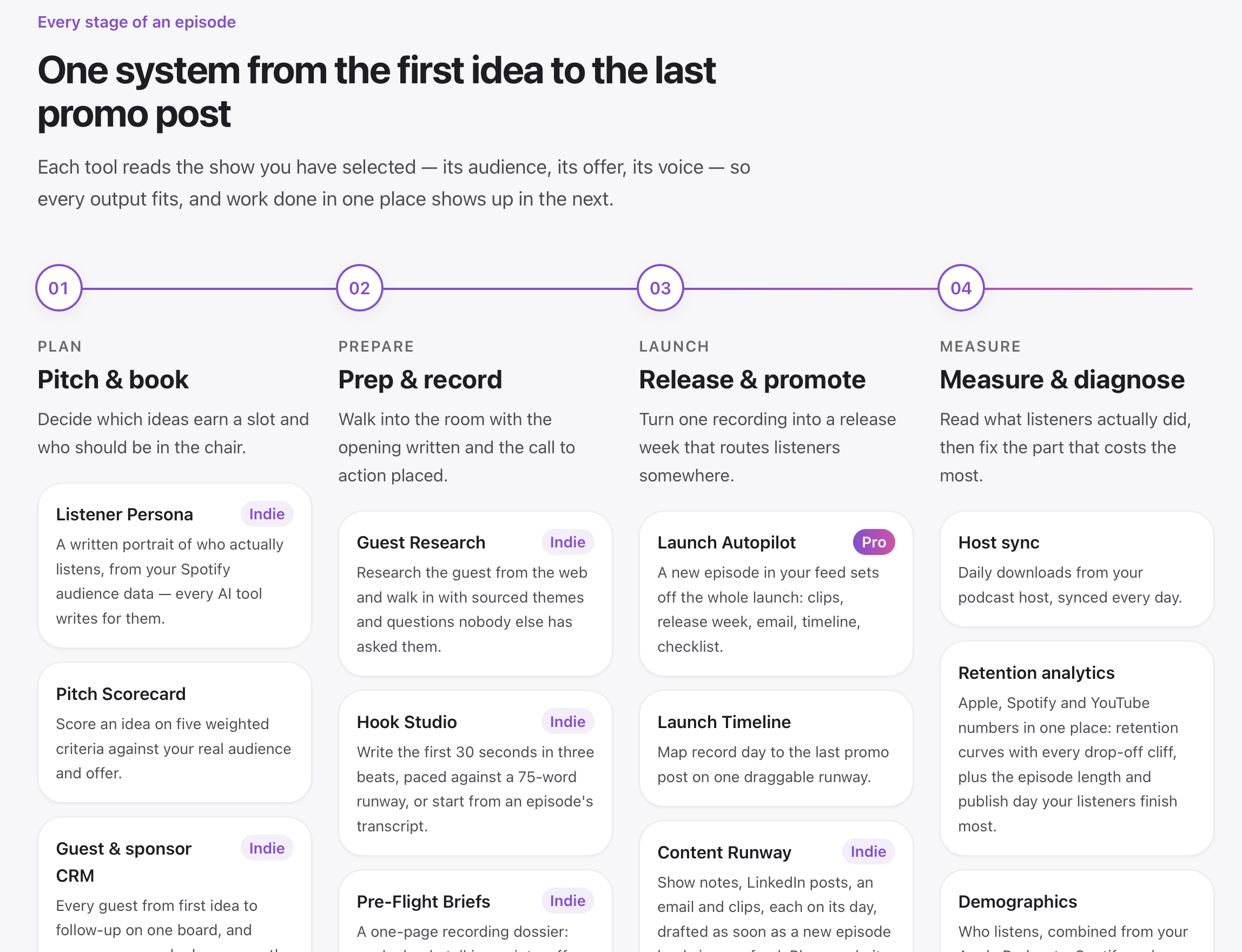
A podcast operates across four distinct phases:
Pre-production and guest management
Hook craft and retention tracking
Structured repurposing and content runways
Listener interaction and feedback loops
Most creators run these four phases across a pile of disconnected tools. Guest pitches live in Gmail. Pipeline stages sit in a spreadsheet. Rough outlines go into Apple Notes. Transcripts live in one browser tab, and ranking spots sit in another. Things get missed constantly. Follow-ups slip. Promotional assets take days to write because you are starting from scratch every time.
When I started mapping Podmaster, the point was not to build another generic AI wrapper. The goal was to build a command center that ties those four areas into a single system.
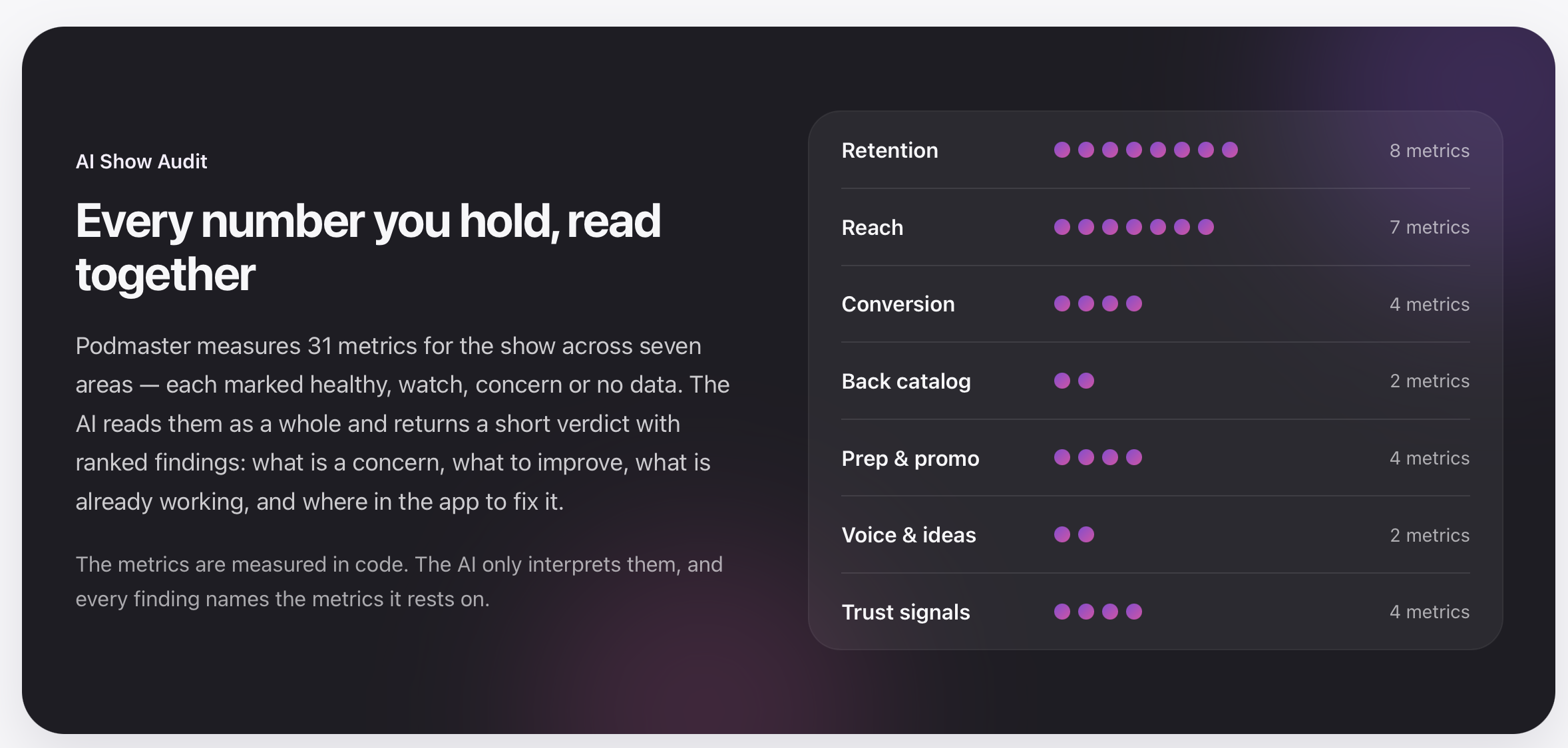
Retention and Show Audits
If people do not stick around, nothing else matters. You cannot build trust, teach a concept, or sell a service if your listener bails while you are still reading housekeeping notes.
Podmaster approaches this with straightforward diagnostic tools.
Visualizing the Curve
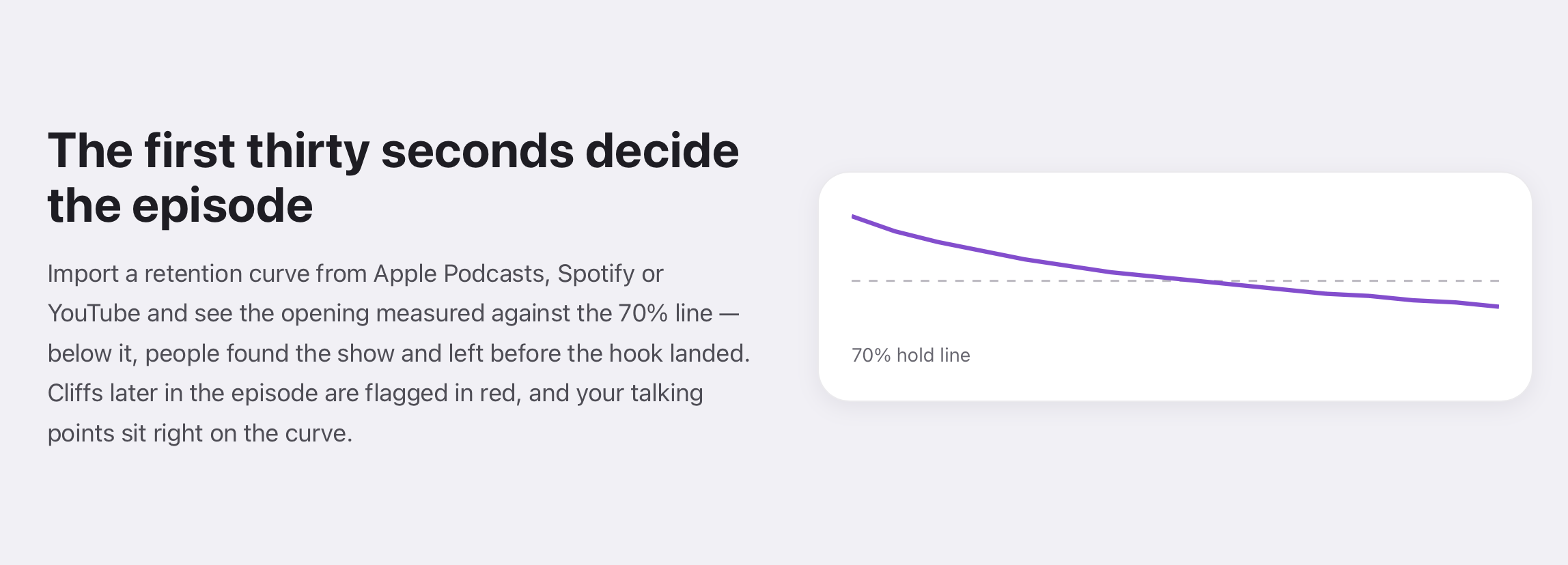
Instead of relying on top-line averages, the app pulls performance data from Spotify, Apple, and your core hosting feeds to map actual retention curves. It looks at specific intervals:
The 30-Second Hook: Did your cold open grab attention, or did people leave before you explained the topic?
Quartile Milestones: Where do the drop-offs happen? Are your sponsor breaks placed at moments that cause friction?
Completion Rates: How many people made it all the way to your call to action?
When you can see the exact spot where people tune out, you stop guessing. You realize rambling three-minute preambles kill episodes, and you fix them.
The Hook Studio and Pitch Scoring
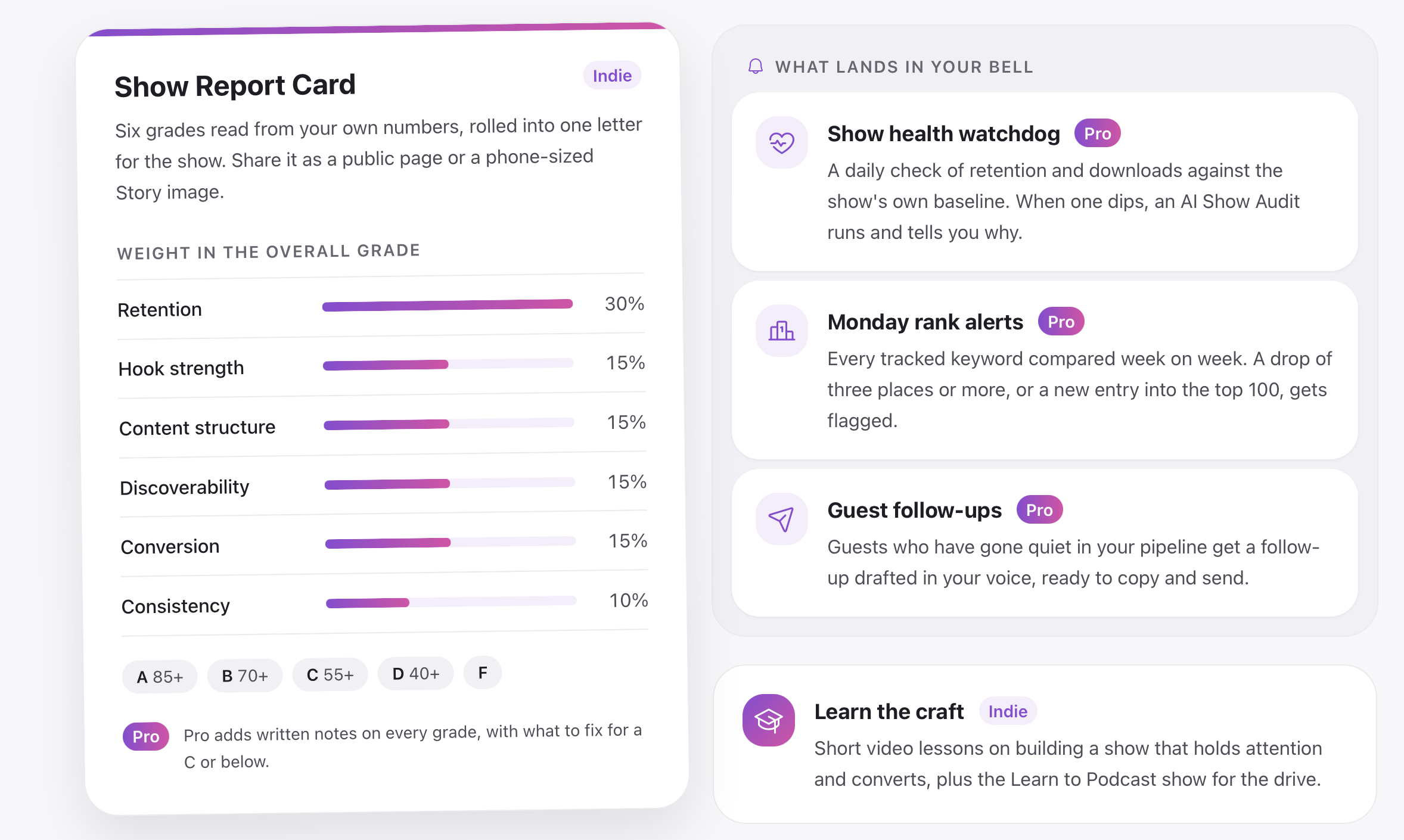
Good episodes are won before you hit record. Podmaster includes a Hook Studio focused on three specific triggers: curiosity, pain points, and narrative promises.
Before recording, you run your ideas through an episode pitch scorecard. The tool checks your angle against clarity, audience relevance, and tension. If an idea scores low, you know to sharpen the packaging before spending an hour talking into a microphone.
Guest Management and Intel
Interviews can build incredible relationships. Yet the admin work of booking guests often turns into a headache.
Most podcasters treat guest booking as a calendar link and nothing more. A guest books a time, shows up, chats for forty-five minutes, logs off, and never hears from the host again. That is a wasted opportunity for everyone involved.
Podmaster replaces that mess with a CRM built specifically for shows.
Pipeline Ingestion
Through inbound webhooks, Podmaster connects directly to scheduling tools like Calendly, Typeform, and Riverside. When someone books a slot:
A profile generates inside your show pipeline.
Intake answers, social links, and bios route straight to their card.
Event logs track their stage from pitched, to scheduled, to recorded, to published.
Instant Guest Briefs
Walking into an interview unprepared leads to dull conversations. You end up asking the exact same questions the guest answered on three other podcasts that month.
Podmaster reviews public background details, recent articles, and career context to assemble a one-page Guest Intel brief:
Core career milestones: You skip the basic resume walk-through and get straight to the interesting points.
Counter-intuitive angles: It surfaces unique takes your guest holds that rarely get airtime.
Targeted question sets: You get thoughtful prompts that keep the conversation moving.
Long-Term Follow-Ups
The real value of an interview often surfaces months after the audio goes live. Podmaster tracks when an episode publishes, reminds you when to send promotional links, and schedules follow-up check-ins down the road. You stop running a churn-and-burn show and start building an actual network.
Content Runways and Repurposing
The biggest trap in audio is spending ten hours making an episode and twenty minutes promoting it.
Most hosts finish recording, export the file, write two quick sentences for the show notes, and tweet a link. Two days later, that episode is dead, buried under everything else on the internet.
To get real mileage out of every recording, you need a content runway: a structured distribution plan that pulls every useful idea out of your source material.
From Audio to Distribution
Podmaster pairs full episode transcripts with asset generators built around narrative beats:
Email briefs: Drafts featuring your main takeaway, paired with alternative subject lines and curiosity hooks.
Social frameworks: Discussion posts and concise takeaways pulled directly from quotes you spoke on air.
Moment Spotter: Algorithmic transcript scans that pinpoint the sharpest sixty-second segments, with exact timestamps, so you know which clips to cut.
Timestamped show notes: Clean chapter breakdowns ready for Apple Podcasts, Spotify, and YouTube descriptions.
Using the Back Catalog
Older episodes should not sit dead in an RSS archive. Podmaster includes a library scan engine that audits your historical feed.
It groups past conversations by topic, spots gaps in your coverage, and helps you bundle related episodes into resource guides or email series. When a listener asks about a specific problem, you can hand them three curated episodes instead of telling them to scroll back two years.
Real Audience Interaction
One major flaw of traditional podcasting is that it is a one-way street. You talk into a mic in an empty room, upload a file, and hear nothing back.
Unless someone goes out of their way to find you on social media or fill out a website form, you have no idea how your words landed. Social comments help, but they lack the personality of voice.
Podmaster builds direct feedback tools right into the listener experience.
Dedicated Q&A Hubs
You can spin up clean question pages where listeners submit topics for upcoming episodes. As questions come in, you star favorites, archive old ones, and pull them into episode outlines with one click.
Direct Audio Voicemails
Podmaster includes an in-browser audio recorder for your listeners. Without installing an app or making an account, someone can open your link, record a sixty-second voice question, and send it to your dashboard.
The platform stores the audio and makes the file available to drop right into your editing software. Bringing real listener voices onto your episodes changes the dynamic of your show. It stops being a lecture and starts being a conversation.
Why I Built This on Stencil
An application like Podmaster usually requires a heavy development footprint. You need relational databases to track shows, episodes, guests, sponsors, and transcripts. You need background workers to parse audio and handle sync jobs. You need interfaces that work well on desktop and mobile.
Usually, you have to pick between two frustrating options:
Custom development: Setting up Next.js or React, spinning up databases, configuring auth, wiring API routes, and writing thousands of lines of boilerplate. That eats up months before you can even test your core ideas.
The no-code glue stack: Patching together Airtable, Softr, Make, and custom webhooks. It works for a week, until an API key expires, a webhook fails, and the whole fragile setup falls apart.
As a Product Experience Specialist at Stencil, I wanted to put our own platform through its paces on a data-heavy project. I did not want to build a simple landing page or a basic demo. I wanted to see how far our prompt-to-software architecture could go with real, daily requirements.
Stencil let me state what I needed built directly:
Custom data models for shows, guest pipelines, and sponsor details.
Granular access controls so user data stays private.
Live API connections to podcast hosts like Transistor for continuous syncing.
Clean interfaces that keep dense information easy to read.
Instead of fighting database migrations or authentication bugs, I focused entirely on how podcasters work, what data they need to see, and where friction slows them down.
The result is a production app running on its own domain, syncing live data, and handling daily production tasks reliably.
What I Learned Building Tools for My Own Work
Building Podmaster reinforced three realities about software and creative work:
1. Domain Knowledge Trumps Code Syntax
The most valuable part of software design is not knowing the latest framework. It is understanding the daily headaches of the person using the tool.
Having hosted shows, booked guests, written show notes, and dealt with finicky gear for years, I knew every pain point in the pipeline. I did not need to guess what a host needs because I live those problems every week. When you build to solve your own friction, you cut the fluff and focus on utility.
2. Disconnected Data Wastes Creative Energy
When your show notes live in one place, your guest info in another, and your numbers in a third, you spend half your time copying and pasting between tabs.
Bringing your workflow under one roof does more than save a few minutes. It protects your attention. You spend less time doing administrative cleanup and more time having good conversations.
3. Building Software Is Open to Anyone Now
You no longer need an engineering team to turn a repeatable workflow into working software. If you understand how a process works step by step, you can turn that logic into an app.
Whether you run a podcast, a photography studio, or a coaching business, you can build tools tailored to your exact needs. Software creation is no longer reserved for full-time developers. It is a practical tool for anyone who wants a cleaner way to work.
The Path Forward
Podcasting is still one of the most effective ways to build trust online. Spending thirty or forty-five minutes directly in someone's ears while they walk the dog, commute, or make dinner builds a connection that short-form social posts cannot touch.
That attention is too valuable to waste on superficial metrics.
If you are putting hours of your life into planning, recording, and editing a show, treat your output with the care it deserves. Stop treating downloads as the finish line. Pay attention to retention. Clean up your guest pipeline. Build repeatable content runways. Give your audience an easy way to talk back.
Podmaster was built to make that workflow practical and sustainable.
If you want to take a closer look at how your own show runs, visit Podmaster. Connect your feed, explore the dashboard, and see what happens when you treat your podcast like an engine.