Scott Wyden Kivowitz
Perfect Panoramic Stitching With No Parallax Using A Nodal Slide
By Scott•
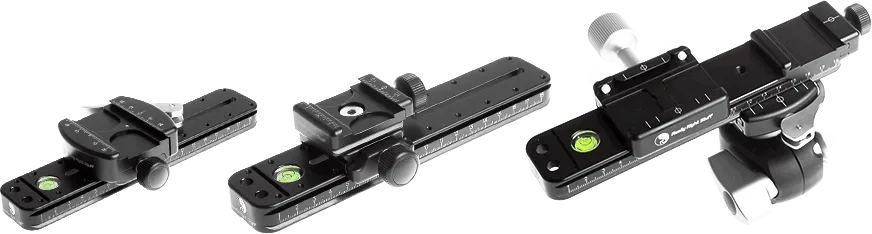
Panoramic stitching can produce artifacts and ghosting by default without any adjustments to the panning point of the tripod.
If fact, the way to achieve perfect panoramic stitching is to make sure that the lens is centered over the panning point of the tripod. The point of the lens that removes the parallax effect is called the entrance pupil or nodal point.
To achieve perfect panoramic stitching, I recommend using a nodal slide.

Nodal slides come in various forms. On some, the camera mounting point is fixed so you must adjust the entire nodal slide to the appropriate point. These types are typically useful when all of your lenses are a general size, like all prime lenses up to 85mm.
Other nodal slides can slide the camera mount in addition to the slide itself. That has more flexibility to cover a wider range of lenses. My nodal slide of choice is the middle one you see above, from Really Right Stuff. This nodal slide has the sliding camera plate as well as a turnable plate so I can use it with collared lenses as well. For example, the 70-200 lens. Anything bigger than a 70-200 and I would have to use a longer nodal slide.
 In my eBook, Go Wider with Panoramic Photography, I walk through the process of finding the nodal point. But I think it's worth briefly covering it here so I am sharing a video of the process so you can see exactly how I do it.
Here is what I recommend for finding your nodal points:
- Tripod with a panning ability
- A way to level the camera perfectly (i.e., bubble level, levelling plate)
- Nodal slide
- Yardstick
- Two identical objects
The video below was recorded for The Arcanum, but I wanted to also make it available for my blog readers to see, along with this article.
It's a quick overview of how to make a parallax free panoramic photograph. For more on panoramas, please pick up my eBook, Go Wider with Panoramic Photography.